Understanding Risk-Taking by Jens O. Zinn
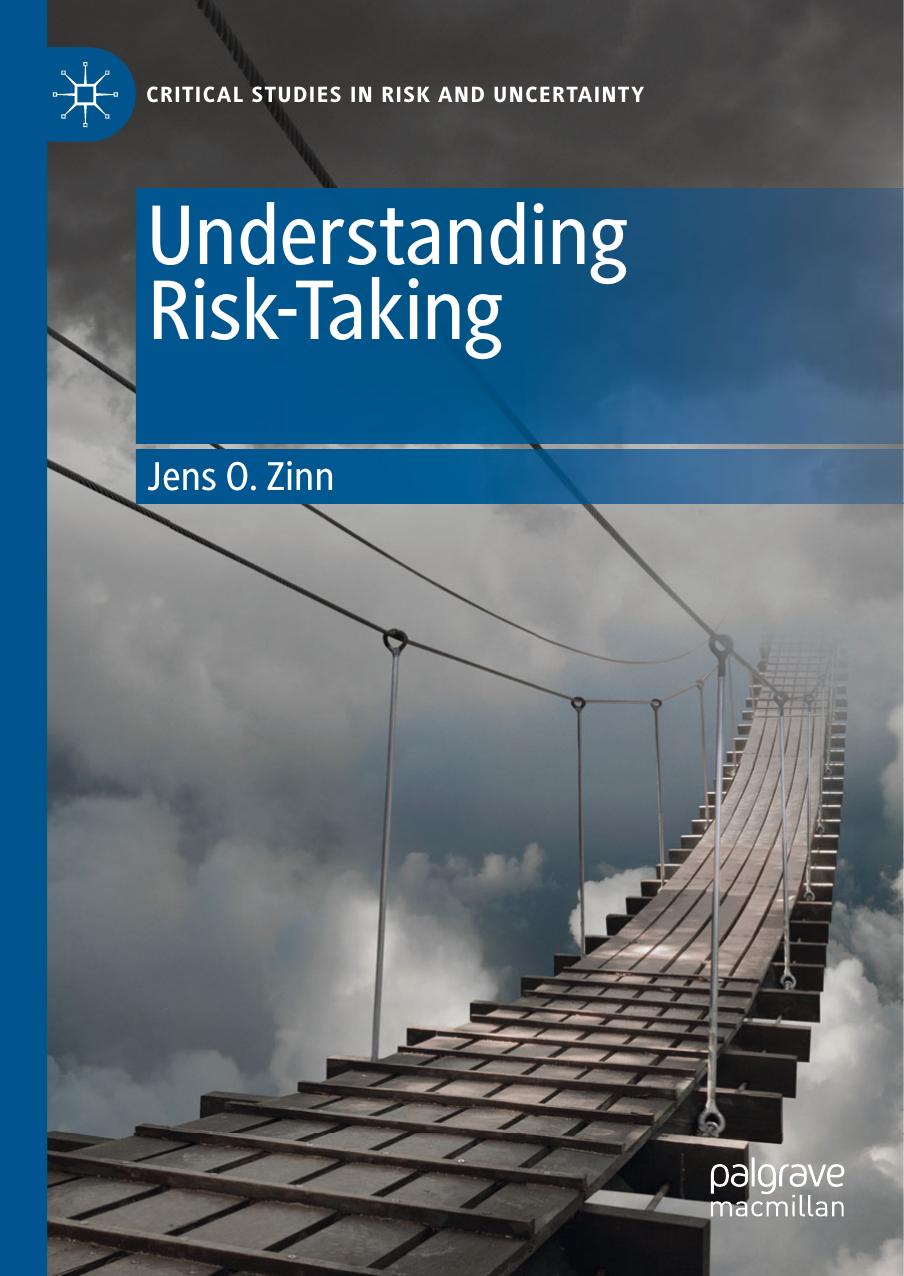
Author:Jens O. Zinn
Language: eng
Format: epub, pdf
ISBN: 9783030286507
Publisher: Springer International Publishing
6.3.1 Developing Identity and Social Innovation
It is a common assumption in public debate that risk-taking is typical for youth which have to find out about their desires, abilities and place in society or—in short—do develop an adult identity. Youth is therefore considered a life phase of increased risk-taking as much as heightened vulnerability during which protection is needed. Thus, taking risks has two functions: first, to find out about oneself and where to position within society and, second, to challenge social boundaries and in so doing foster social change.
Youth and adolescence are domains where concerns about risk-taking are prevalent all over the world (Crosnoe and Johnson 2011). The concerns about youth as a social group which is at risk because of its risk-taking behaviour seem even to increase rather than to decrease (Sharland 2006; Ponton 1997: 2). At the same time, this has been a domain where the tension between risk-taking and risk avoidance is most obvious. For example, Gert Biesta (2014) argued in The Beautiful Risk of Education that there is a tension in the desire to protect youth against risk and the constitutive element of education and learning that is risk-taking. He suggests that ‘if we take the risk out of education, there is a real chance that we take out education altogether’ (ibid.: 1).
Similarly, observations have been made more than ten years earlier, when Lightfoot (1997) argues in her qualitative study on youth in North Caroline (USA) that in the late 1980s, the traditional troubled youth perspective in developmental psychology became complemented by a more positive approach which interprets risk-taking behaviour as ‘pursuit of opportunities for self-transcendent challenge’ (Baumrind 1987: 98). Having said this, the vulnerability of teenagers remained a major issue and the concerns that youth take wrong risks with serious and long-lasting effects (Ponton 1997; Lightfoot 1997). Consequently, Ponton (1997) argues for strategies not to prevent risk-taking as such but to channel youth risk-taking in less harmful avenues. She as others (e.g. Irwin 1993) distinguishes between normal explorative behaviour and behaviour that is actually very dangerous.2 Lightfoot (1997: 166) agrees but seems to be more open to the idea that there is no way ‘to provide children with opportunities for safe risk-taking. We can only provide them with opportunities for experience, realising that out of these they will construct something remarkable that will become their lives’.
And she found support in the responses of the participants in her study. As one teenager stated: ‘The only way to get experience is to take risks’ (quote of a 17-year-old teenager, Lightfoot 1997: 97). It is about ‘growth – inner growth and a feeling of independence and maturity in trying something new’ (16-year-old teenager, Lightfoot 1997: 97). It is less the lack of knowledge than this specific risk-taking attitude, to find out about yourself and to position yourself in the social realm, which motivates youth risk-taking. Part of this is challenge authorities rather than just complying. This is one of the reasons why attempts to prevent youth risk-taking such as unprotected sex, consuming illicit drugs and others are often relatively inefficient.
Download
This site does not store any files on its server. We only index and link to content provided by other sites. Please contact the content providers to delete copyright contents if any and email us, we'll remove relevant links or contents immediately.
| Anthropology | Archaeology |
| Philosophy | Politics & Government |
| Social Sciences | Sociology |
| Women's Studies |
Nudge - Improving Decisions about Health, Wealth, and Happiness by Thaler Sunstein(7711)
The Fire Next Time by James Baldwin(5452)
iGen by Jean M. Twenge(5418)
Adulting by Kelly Williams Brown(4580)
The Sports Rules Book by Human Kinetics(4395)
The Hacking of the American Mind by Robert H. Lustig(4386)
The Ethical Slut by Janet W. Hardy(4261)
Captivate by Vanessa Van Edwards(3842)
Mummy Knew by Lisa James(3694)
In a Sunburned Country by Bill Bryson(3546)
The Worm at the Core by Sheldon Solomon(3489)
Ants Among Elephants by Sujatha Gidla(3468)
The 48 laws of power by Robert Greene & Joost Elffers(3294)
Suicide: A Study in Sociology by Emile Durkheim(3024)
The Slow Fix: Solve Problems, Work Smarter, and Live Better In a World Addicted to Speed by Carl Honore(3013)
The Tipping Point by Malcolm Gladwell(2929)
Humans of New York by Brandon Stanton(2875)
Get What's Yours for Medicare: Maximize Your Coverage, Minimize Your Costs by Philip Moeller(2758)
Handbook of Forensic Sociology and Psychology by Stephen J. Morewitz & Mark L. Goldstein(2707)
